A properly installed radon system usually makes a basement slightly drier and does not cause mold by itself. What a Pennsylvania study found, and the two places a system can add moisture.
Chapters
- 0:00 Slightly drier, and no mold by itself
- 0:10 Two unrelated problems
- 0:20 Shared entry routes
- 0:30 The Pennsylvania study
- 0:40 Drier outside summer
- 0:50 Little effect in humid summers
- 1:00 Condensation in the vent pipe
- 1:10 Where dampness can start
- 1:20 The order: water, mold, radon
- 1:30 Certification in Pennsylvania
- 1:40 Retest when the work is done
Transcript
0:00 A properly installed radon system usually makes a basement slightly drier, and it does not cause mold by itself.
0:10 Mold and radon are unrelated problems. Radon is a radioactive gas from the soil. Mold is a growth that needs moisture.
0:20 They share the basement, the foundation cracks, and the pressure difference that pulls soil air indoors. Neither one causes the other.
0:30 An EPA-funded study monitored three Pennsylvania houses near Harrisburg for twelve to eighteen months, switching their radon systems on and off.
0:40 Outside summer, basement humidity dropped four to ten points, and hollow block walls dried by eighteen to thirty points.
0:50 In humid summer months the effect was much smaller or negligible, and the fan can draw warm, moist outdoor air inside.
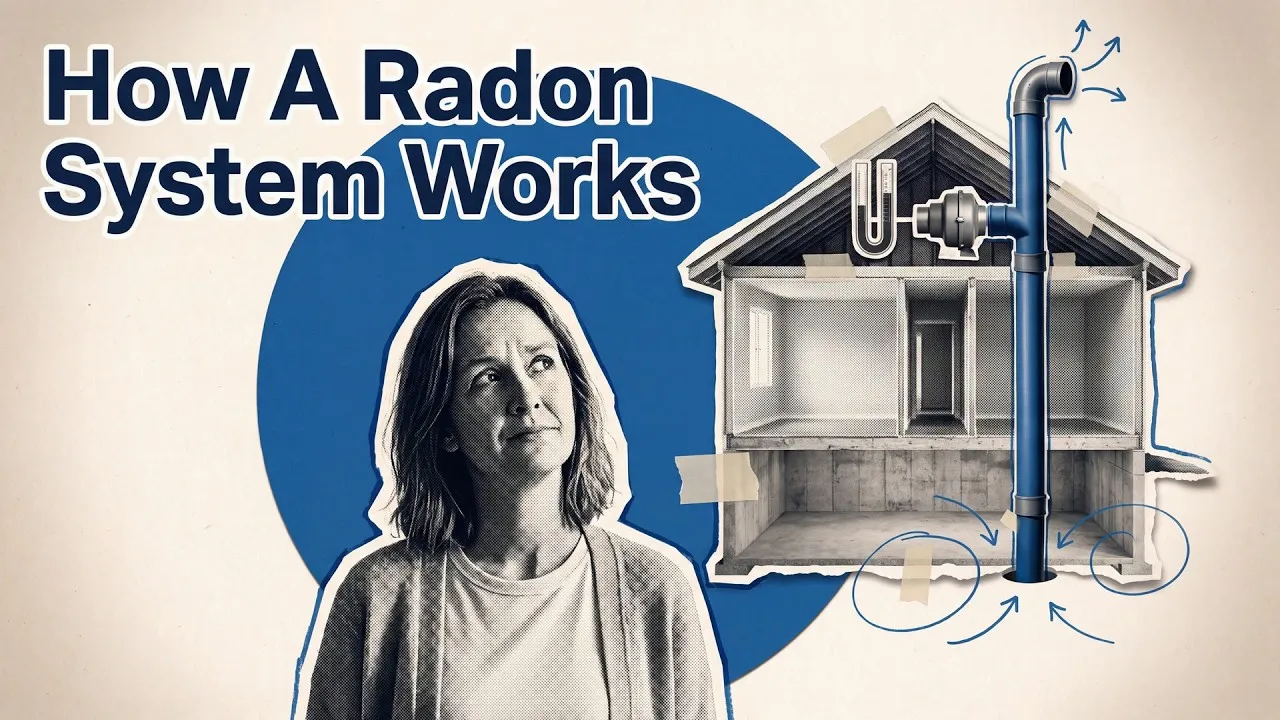
1:00 Condensation forms inside the vent pipe where it crosses a cold attic or garage. That water must drain to the slab.
1:10 A dripping joint above a finished wall, or a crawlspace membrane with open seams, creates exactly the dampness that mold needs.
1:20 A radon system never fixes water entry. Correct the drainage first, then remediate the mold, then install the radon system.
1:30 Pennsylvania certifies radon testers and mitigators. Mold contractors are not licensed here, so check their registration and insurance before hiring.
1:40 Whatever the order, retest for radon once the work is finished. Find certified contractors at Radon Mitigation In York dot com.
Key points
- A properly installed radon system usually makes a basement slightly drier and does not cause mold by itself.
- In an EPA-funded study of three Pennsylvania houses near Harrisburg, monitored for 12 to 18 months with the systems switched on and off, basement relative humidity fell 4 to 10 points outside summer, and hollow block walls dried by 18 to 30 points.
- In humid summer months the effect was much smaller or negligible, and the fan can draw warm, moist outdoor air into the basement.
- Two places a system can add moisture: condensation inside the vent pipe where it crosses a cold attic or garage (it must drain back to the slab), and a crawl space membrane with open seams.
- A radon system never fixes water entry. Fix the drainage first, then remediate any mold, then install the radon system, and retest for radon when the work is finished.
Find a contractor in York
Compare DEP-certified radon mitigation companies and contractors serving York, or read the full guide to radon systems and mold.
Read the full guide: Does a radon mitigation system reduce humidity or cause mold?