
Does a radon mitigation system reduce humidity or cause mold?
An EPA study of three Pennsylvania houses found radon systems dried basements except in summer. What the system does to moisture, and when it can cause mold.
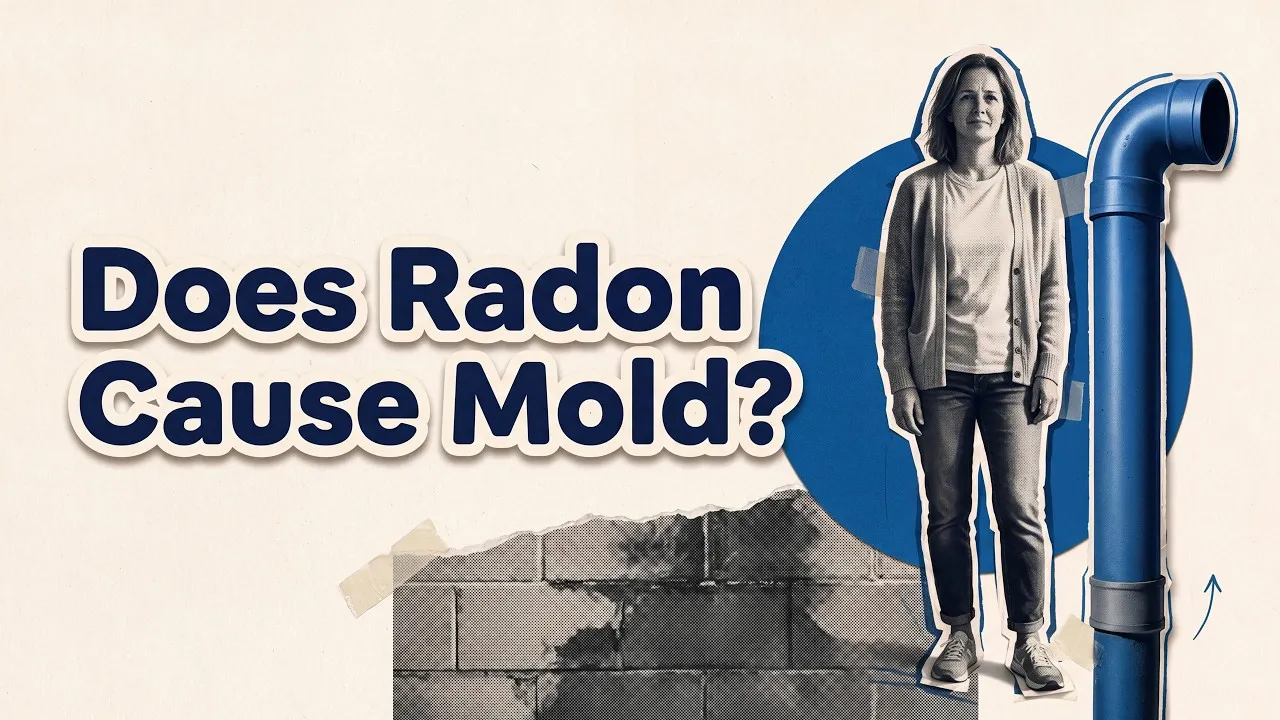
A properly installed active radon system usually leaves a basement somewhat drier outside summer, and it does not cause mold by itself. Mold and radon have no causal connection in either direction; they share the basement, the same foundation openings and the same wet soil, which is why so many York County homes have both.
What an active system does to basement moisture
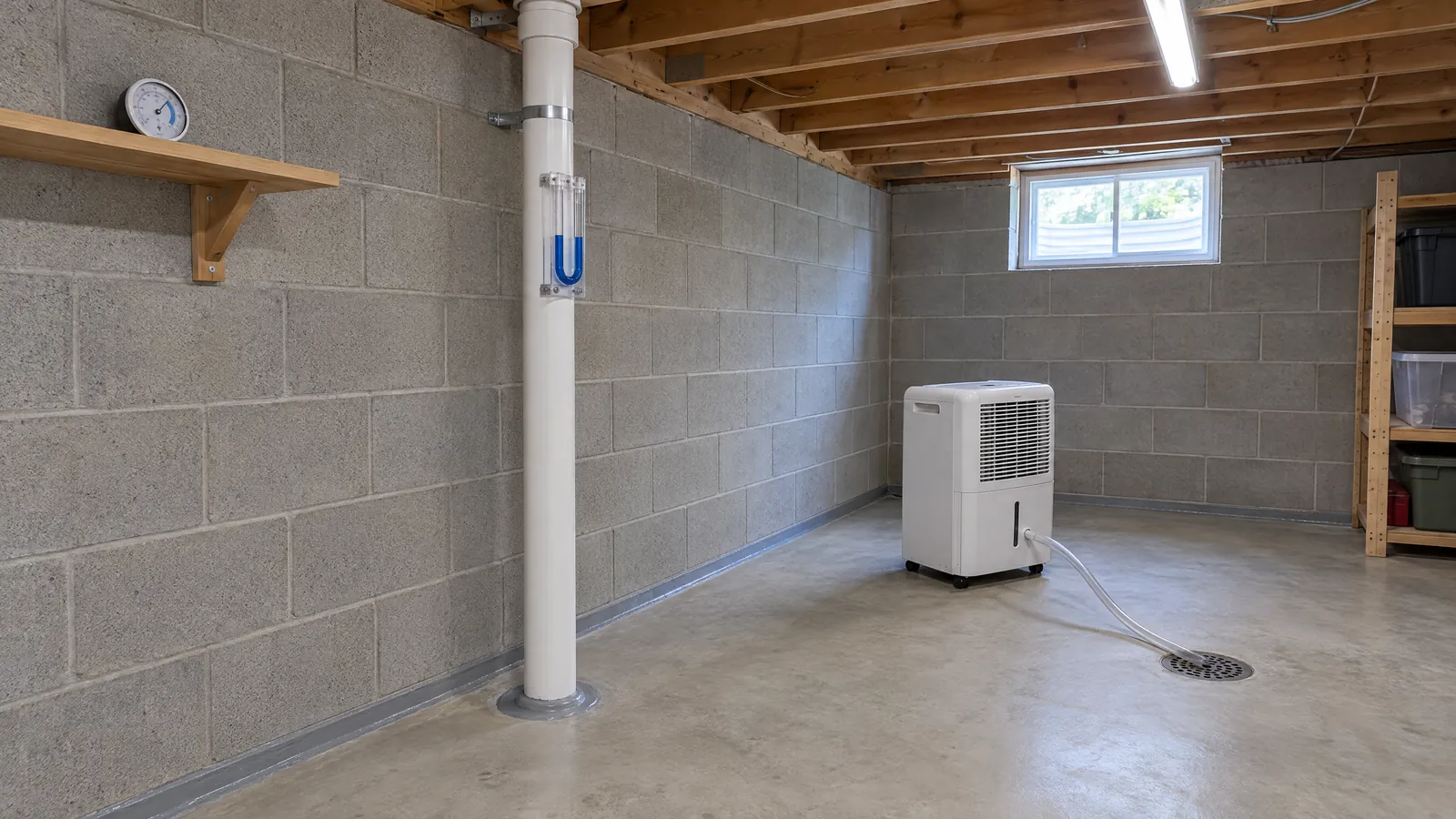
An active sub-slab system keeps the air under the slab at lower pressure than the basement, so soil gas goes into the pipe instead of the house (how a system works). Soil air carries water vapour as well as radon, so the fan removes some moisture too.
The only controlled measurement is a 2007 EPA-funded study by Turk and Hughes on three houses near Harrisburg, monitored for 12 to 18 months with the systems switched on and off. Outside summer, basement air relative humidity fell 4 to 10 points while the systems ran; humidity inside hollow block wall cores fell 18 to 30 points, and poured walls and slabs changed less than 3 points.
In summer the reductions were "much smaller or negligible", and the authors noted a system can then add moisture by drawing warm humid outdoor air in. They cautioned that three houses may not represent others.
Contractors' reports of drier basements point the same way but are anecdote from people who sell the systems. Expect somewhat drier from autumn to spring, little change in a York County July, and no change to liquid water entry; the study called active systems "probably not well-suited" to dampness from bulk water. Fix the water source.
Video answer: Does a radon mitigation system dry your basement or cause mold?
When a radon system can create mold conditions
Four installation faults produce the dampness mold needs.
- Pipe and fan condensation. Moist soil air cools in the pipe where it crosses a cold attic, garage or the outdoors. Manufacturers require condensate to drain back to the suction point; bypasses exist for freezing weather. A joint dripping into a finished wall or onto joists is a mold site, and the EPA says the fan belongs in unconditioned space, never in or below a living area.
- A crawlspace membrane with open seams. Sub-membrane depressurisation, heavy plastic over the earth floor with the fan drawing from beneath, is the method the EPA calls most effective for crawlspace homes. Gaps, unsealed seams or tears let soil moisture reach the framing and condense on cooler joists and subfloor. Sealed with suction beneath, it reduces soil moisture; loose, it can be worse than none.
- Pulling humid outdoor air in. York's muggy season typically runs late May to late September; air drawn in then can condense on cold pipes, ducts and below-grade walls, though no source has measured how much.
- Backdrafting. The hazard here is carbon monoxide. A 1997 EPA study found active systems should not cause backdrafting in most houses but could in tight ones, and called for spillage testing on essentially every installation. With a natural-draft furnace or water heater, ask for that test.
Does humidity or a wet basement raise radon
Not directly. Radon entry is driven by pressure: indoor air is usually at lower pressure than the soil, so the house acts like a vacuum on the soil beneath it. Wet soil matters because the soil air that carries moisture carries radon too.
One moisture fix raises radon measurably. A crawlspace encapsulated without a vent under the membrane traps soil gas: a 2010 ASHRAE study of eight homes measured sealed, conditioned crawlspaces at roughly three to ten times the radon of vented ones. Suction beneath the plastic turns the same membrane into a radon system; if a contractor proposes encapsulation, ask about the vent.
Mold and radon share a basement, not a cause
Radon forms from the decay of uranium in rock and soil and enters through floor cracks, construction joints, wall cracks, gaps around service pipes, sump pits and crawlspace floors. Water uses the same openings, and the EPA's rule for mold is that mold control is moisture control.
York County is EPA Radon Zone 1, and the EPA still says to test every home regardless of zone. DEP estimates about 40 percent of Pennsylvania homes tested are above the 4 pCi/L action level; its database of 2.3 million basement tests shows a mean of 6.8 pCi/L and 38 percent at or above 4. Why York County runs high covers the rock; the ZIP code guide has local results.
Older houses add to the overlap: the Harrisburg study noted that most houses with moisture complaints had hollow block walls, whose cores are also a radon pathway.
On health: radon is the second leading cause of lung cancer in the US, about 21,000 deaths a year by EPA's estimate. Mold is linked to upper respiratory symptoms, cough, wheeze and asthma attacks; CDC says "black mold" should be treated like any other mold. Neither is an emergency; both are worth fixing.
If you have both problems, what order
Water first, mold second, radon third, test last.
- Fix the water source. Mold returns unless the moisture problem is completely fixed, and bulk water defeats a radon system's drying effect.
- Remediate the mold. Remediation can remove drywall, block-wall facing or crawlspace floor coverings. Done first, it cannot damage the pipe, pit or membrane, and the mitigator seals the new openings afterwards; the EPA says sealing alone has not been shown to lower radon reliably, but it helps a system.
- Install the radon system, run the post-mitigation test, and retest every two years.
One caveat. Professional remediation over about 10 square feet runs containment under negative pressure with a HEPA-filtered fan exhausting outdoors, which may temporarily change radon entry while the machines run. No study has measured it and the effect ends when the machines stop, so it is no reason to skip remediation; test afterwards if the house has never been tested.
The counter-case: radon has a defined threshold and a one-day fix. If a confirmed test is well above 4 pCi/L, especially with a smoker in the house, install the system first, tell the mold contractor, and retest when everything is done.
Who to hire
Pennsylvania has required DEP certification for radon testers and mitigators since 1988 under the Radon Certification Act; anyone paid to alter a building to reduce radon needs the mitigation certification. DEP publishes a monthly Radon Services Directory, and certified people carry a DEP ID card; DIY vs a DEP-certified contractor explains how to check a number.
Pennsylvania does not license mold remediation contractors; the only state requirement is Attorney General home-improvement registration for firms doing $5,000 or more a year, with $50,000 minimum insurance for bodily injury and for property damage. Some firms hold both, most do not, and a mold company cannot install a radon system without the DEP certification. If mold is your main problem, the sister guide mold and radon in Gettysburg homes covers that side.
Ask the radon contractor for the DEP number, a written post-mitigation test, condensate drainage and a spillage check if there are natural-draft appliances; ask the mold contractor for registration, insurance, a moisture-first scope, containment with HEPA exhaust and post-remediation verification. Prices: what a radon system costs in York.
Questions people ask
Does a radon system remove moisture? Some, outside summer: 4 to 10 humidity points in basement air and 18 to 30 in block walls. It does not remove liquid water, and in summer it can add moisture.
Does moisture affect radon levels? Radon entry is driven by pressure. Wet soil air carries radon with it, and a crawlspace sealed against moisture without a vent has measured three to ten times the radon of a vented one.
Can a radon test detect mold? No. A radon test measures one radioactive gas, and CDC does not recommend mold testing; find the moisture and fix it. Radon testing in York County covers kits and monitors.
Is radon worse in basements? Usually. DEP says to test in the basement because levels are often highest there; statewide, basement tests average 6.8 pCi/L and first-floor tests 3.6.
Finding a contractor
This site is a directory of DEP-certified radon testing and mitigation companies serving York and York County; it does not test or mitigate. Browse the contractor listing and tell the company if mold work is planned. Questions about the listings: (223) 21-RADON or hello@radonmitigationinyork.com.