The radon fan is the one part of a system that wears out. How to read the manometer, what a failing fan sounds like, what replacement costs in York County, and why bigger is not better.
Chapters
Transcript
0:00 Radon systems have one part that wears out. The fan runs nonstop and lasts roughly ten years, less when mounted outdoors.
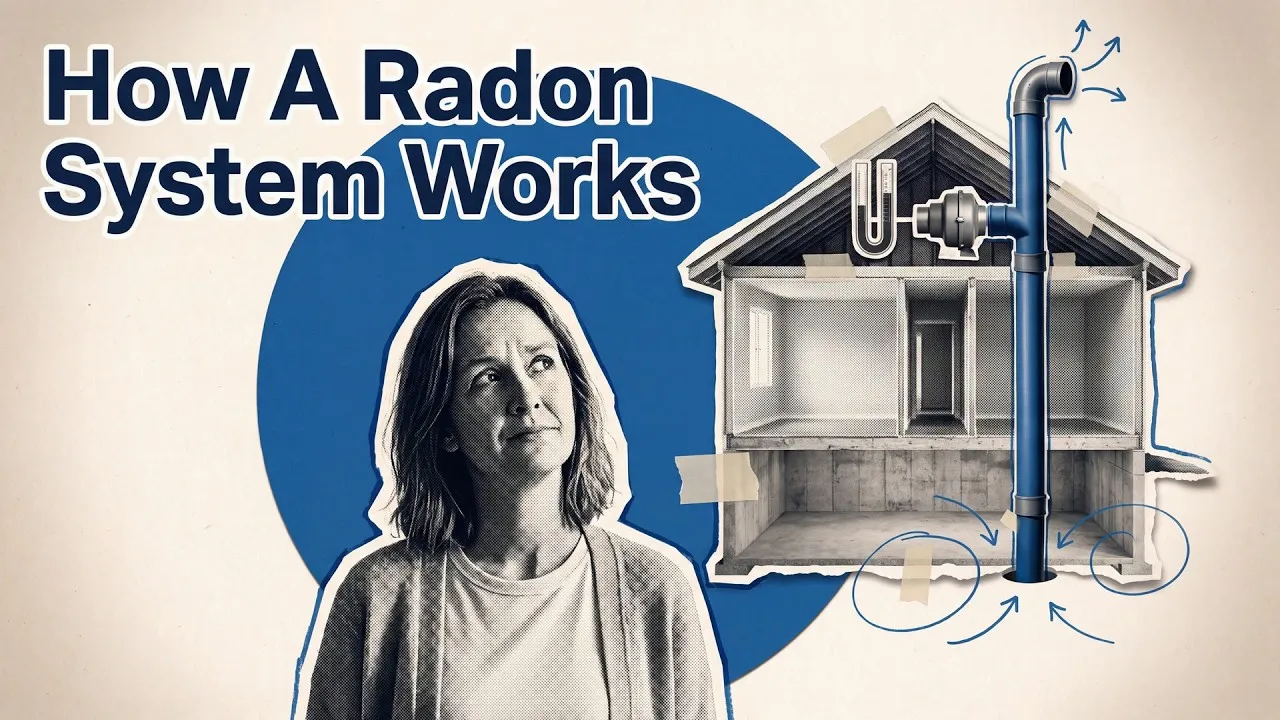
0:10 A level manometer is the first clue: equal liquid columns mean no suction, so the fan stopped or the pipe is blocked.
0:20 Listen at the fan in the attic or exterior housing: a running fan makes a low hum, and silence means it's off.
0:30 The opposite warning is noise: rattling or vibration means bearings are going, or ice is in the pipe during a cold snap.
0:40 Replacement runs three hundred to six hundred dollars, and bigger isn't better: an oversized fan can pull conditioned air from the house.
0:50 Activating a passive rough-in costs five hundred to a thousand. Find certified contractors at Radon Mitigation In York dot com.
Key points
- The fan is the only part of a radon system that wears out. It runs nonstop and lasts roughly ten years, less when it is mounted outdoors.
Three ways to tell it has stopped
- The manometer is level. Equal liquid columns in the U-tube mean there is no suction: the fan has stopped or the pipe is blocked.
- The fan is silent. A running fan in the attic or the outside housing makes a low hum.
- The fan is noisy. Rattling or vibration means the bearings are going; in a cold snap it can also mean ice in the pipe.
What it costs
- Fan replacement: about $300 to $600 in York County.
- Bigger is not better: an oversized fan can pull heated or cooled air out of the house.
- Turning a passive rough-in (pipe but no fan) into an active system: about $500 to $1,000.
Retest after any fan replacement.
Find a contractor in York
Compare radon fan service and DEP-certified mitigation companies, or read the full fan guide.
Read the full guide: Radon fan replacement, repair and passive system activation